Wednesday
November 11th
09:00
Primary schools
Windows on the past
IV-V primary school
place
At school, in an institute in the city
Ticket
for schools, upon reservation
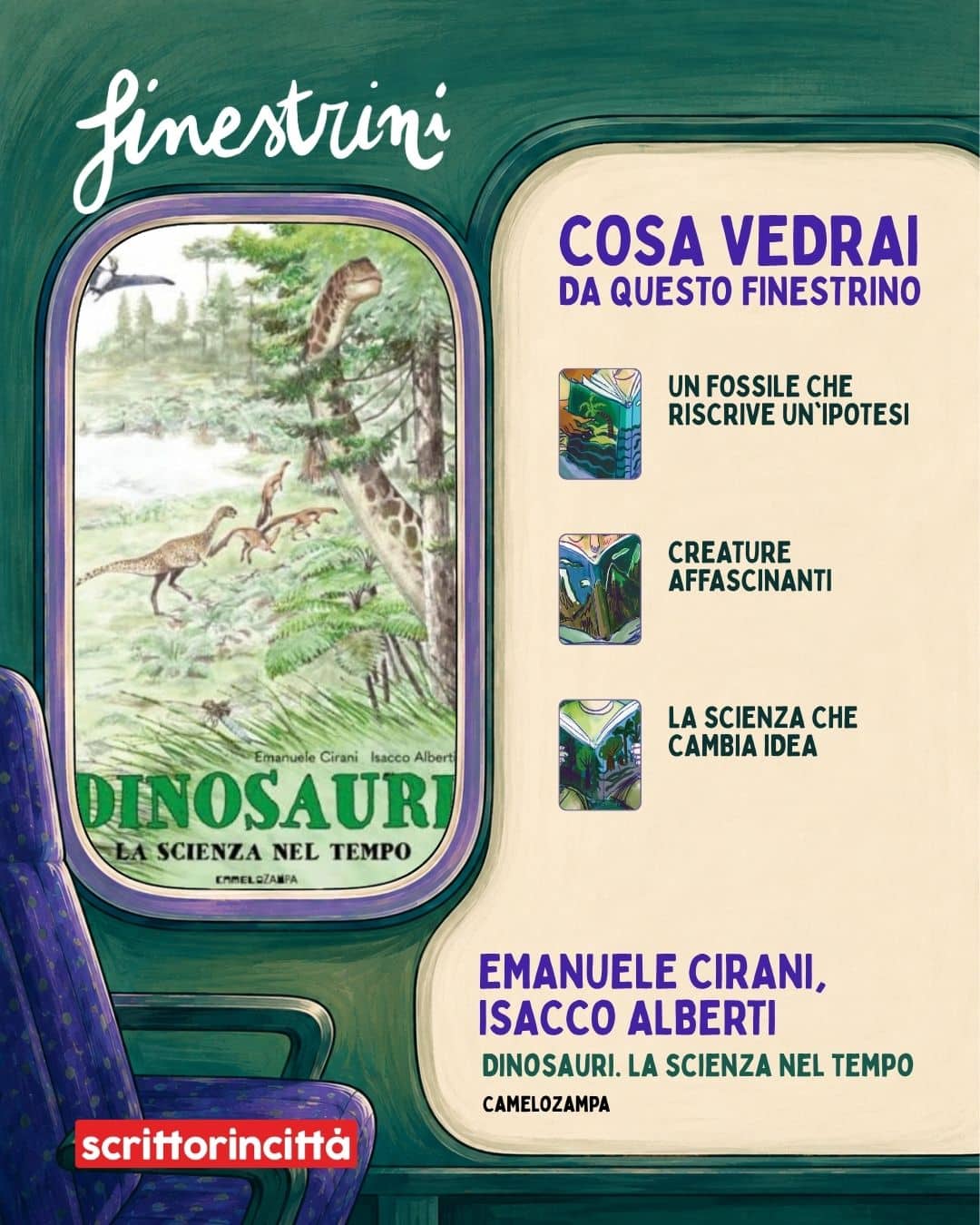
How do we know what dinosaurs looked like if no one has ever seen them? From the slow, clumsy creatures of the past, they are now thought to be active, often feathered animals, capable of complex behaviors. How are hypotheses formulated, how are evidence interpreted, and why can every fossil discovery overturn what we thought we knew? Emanuele Cirani and Isacco Alberti (Dinosaurs. Science Through Time, Camelozampa) open a window on the way science looks at the past: not a fixed gaze, but one in constant motion, changing with each new discovery.
How do we know what dinosaurs looked like if no one has ever seen them? From the slow, clumsy creatures of the past, they are now thought to be active, often feathered animals, capable of complex behaviors. How are hypotheses formulated, how are evidence interpreted, and why can every fossil discovery overturn what we thought we knew? Emanuele Cirani and Isacco Alberti (Dinosaurs. Science Through Time, Camelozampa) open a window on the way science looks at the past: not a fixed gaze, but one in constant motion, changing with each new discovery.
scrittorincittà is supported by




scrittorincittà was created with the patronage of the European Commission Representation in Milan